5 Essential Tips for Maintaining Warehouse Safety
Updated: 21 October 2026
Download Our Racking Inspections Brochure
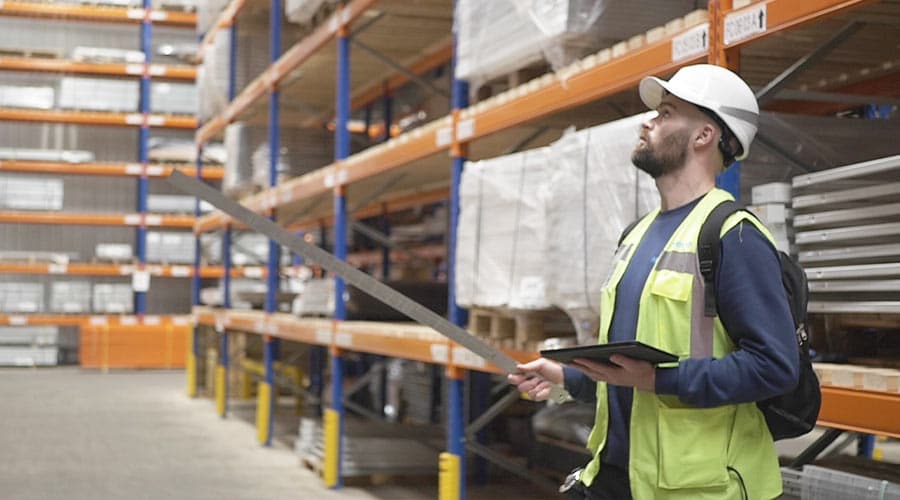
Keeping your workforce as safe as possible when working in a warehouse should be of paramount importance to employers. By raising safety standards, you can improve morale, reduce work related accidents and save money in the long term by decreasing the number of workplace incidents.
Implementing the basics of correct workwear, training and safety checks is paramount.
Wear Personal Protective Equipment (PPE)
Sourcing the correct PPE, including hard hats, earplugs and hi-vis vests, to protective footwear and gloves is imperative, along with enforcing that workers wear the correct protective equipment at all times. It is also important that spare protective equipment is readily available in the warehouse, in case a worker’s gear is damaged and needs replacing immediately.
Inspect for Hazards
Warehouse spaces need to be clean and regularly checked that there is no debris on walkways and eliminate any unnecessary hazards. You should carry out regular visual inspections, along with expert racking inspections that are carried out at least once a year by a SEMA Approved Racking Inspector (SARI).
Provide Racking Training
The majority of warehouse accidents occur when workers are not sure what they are doing, or do not have sufficient training for the particular task in hand. Along with ensuring that all workers receive the correct training, running refresher courses several times a year is also helpful in keeping workers up to date with safety standards. You should promote a culture of mindfulness and awareness in a warehouse environment.
Implement Safety Signage
Signage throughout the warehouse does not only remind workers to wear their protective gear, but it can also warn workers of any potential hazards. Clearly display your warehouse signage on aisles, next to machinery and in high footfall areas, helping to ensure workers take extra care. You can also use signage to indicate walkways and forklift routes to ensure workers do not walk in high traffic routes.
Invest in Racking Protection
It is common for a forklift to collide with racking, particularly at the lower section of the uprights in the racking and in narrow aisles. Investing in rack deflektors and racking protection allows for these protective barriers to take the impact of collisions, and potentially prevent the racking from being damaged. This upright protection can be one of the most cost-effective solutions, eliminating the need of replacement racking. Other racking protection solutions include; anti-collapse mesh decking, end of rack barriers, pallet back stops and warehouse barriers.
Spot the signs of racking damage
Learn how to recognise common signs of pallet racking damage and what steps to take when you identify a problem.
Read The Blog
In a warehouse, the main causes of accidents in warehousing and storage are:
Do your research and invest in high quality racking
This should include the equipment, service and installation from the provider, such as Nene. They should carry out full site assessments, be SEMA accredited to carry out install, and design your racking to the specification of your product and stock needs, taking into account the space you have and the workflow of your teams.
INDG412 | Warehousing and storage – keep it safe
https://www.hse.gov.uk/pubns/indg412.pdf
HSG76 | Warehousing and storage – A guide to health and safety
https://www.hse.gov.uk/pubns/priced/hsg76.pdf
Make Racking Safety Part of Your Routine
Nene’s racking inspection service helps assess storage equipment, document findings and identify actions to address potential risks.
Book a Racking Inspection
Get In Touch
Warehouse teams should take a shared responsibility in ensuring that workplace safety practices are adhered to. By building a strong culture around workplace safety, this will drive efficiencies and wellbeing for everyone involved.
If you require more information on this topic, please contact our experts at Nene and we will be happy to support you with your racking protection and inspection needs.